
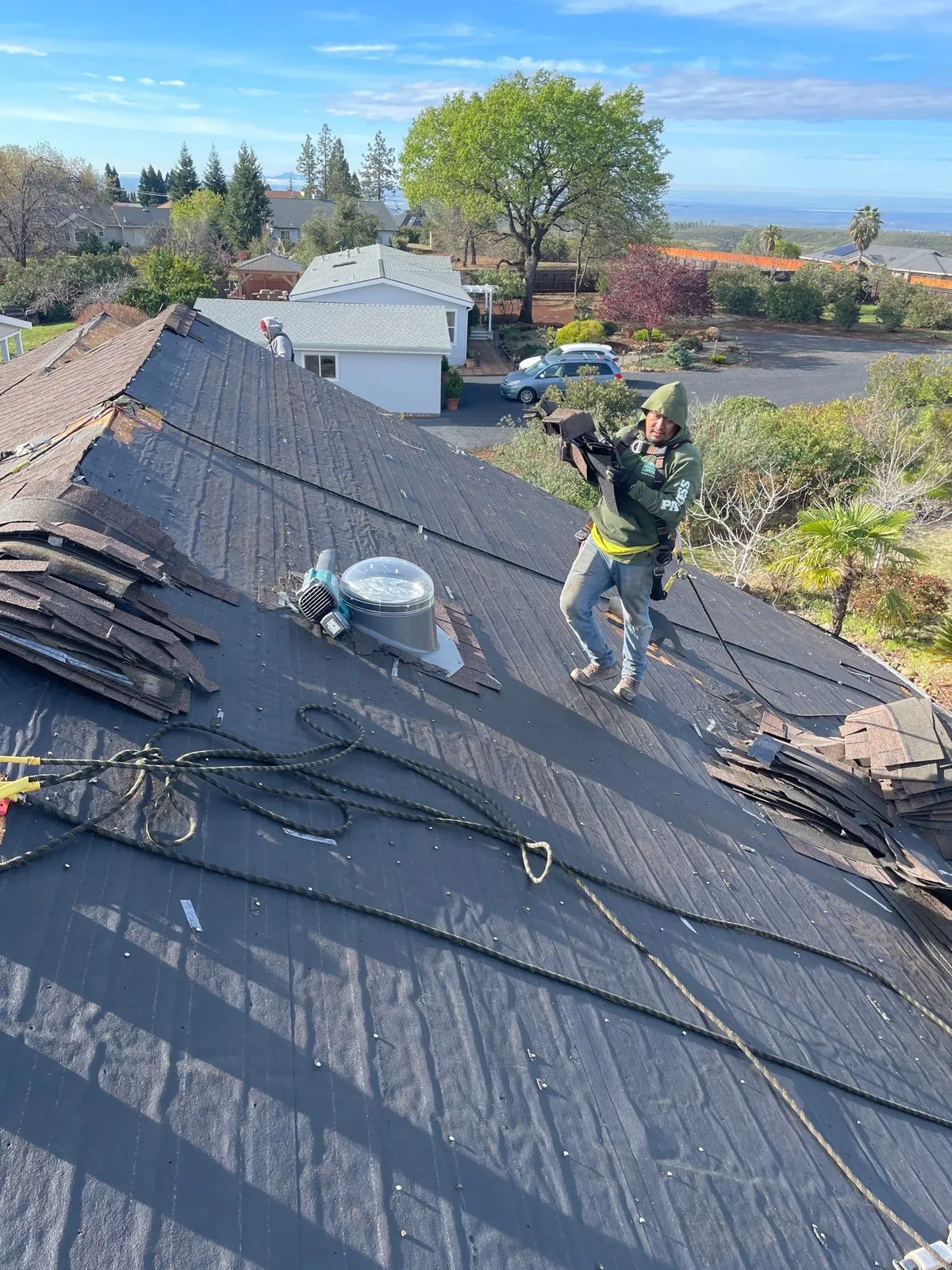
Roof underlayment is the layer between your roof decking and the shingles, tile, or metal on top. It is your roof's second line of defense. It catches water that gets past the roofing, protects the deck during installation, and on tile roofs it does most of the real waterproofing. There are three main types: asphalt-saturated felt, synthetic underlayment, and self-adhered membrane. On most roofs we install today, synthetic is the right base layer, with self-adhered membrane in the spots that see the most water.
Here is why, and what to ask for on your next roof.
What underlayment actually does
No roof covering is perfectly watertight on its own. Wind drives rain sideways under shingle tabs. Water wicks under tile laps. Valleys carry runoff from two slopes at once. Some water always gets past the top layer.
Underlayment catches that water and carries it down to the eave. It also:
- Protects the decking from rain during installation
- Adds a layer between the roofing and the deck for fire ratings on some assemblies
- Keeps the roof dry if shingles blow off in a wind event until repairs are made
When underlayment fails, water reaches the wood. That is when you get soft decking, stains, and leaks that seem to come from nowhere.
The three main types
Asphalt-saturated felt
Felt was the standard for decades and is still on most older homes in Chico. It is a paper or fiberglass mat saturated with asphalt, sold in two common weights (often called 15-pound and 30-pound).
Felt works, but it has drawbacks:
- It dries out. Under Valley heat, the asphalt slowly cooks out, and the felt gets brittle and cracks. Under tile, where it is shielded from the sun but still sits in a hot attic environment for decades, we routinely find felt that crumbles in our hands.
- It wrinkles when wet. Felt that gets rained on during installation can buckle, which shows through shingles.
- It tears more easily under foot traffic and in wind during installation.
Synthetic underlayment
Synthetic underlayment is a woven or spun polymer sheet, usually polypropylene or polyethylene. It has largely replaced felt on new roofs, for good reasons:
- Stronger and more tear-resistant, which makes for a safer, cleaner installation
- Lighter, with larger rolls and fewer seams
- Does not dry out the way felt does in the heat
- Better walking surface for crews on pitched roofs
- Can be left exposed longer during installation, within the manufacturer's stated limits
Not all synthetics are equal. Some are rated for higher temperatures, which matters under metal roofs that get very hot in a Chico July. Manufacturers also specify which underlayments are approved for their shingle and tile systems.
Self-adhered membrane
Self-adhered membrane is a rubberized asphalt sheet with a sticky back. It bonds directly to the decking and seals around nails driven through it. In snow country it is called "ice and water shield." Here, we do not need it for ice dams, but it is the best protection in the places where water concentrates:
- Valleys
- Around chimneys, skylights, and walls
- Around vent pipes and other roof penetrations
- Low-slope sections where water moves slowly
Some manufacturers also call for it at the eaves. On a high-end roof, especially metal, some homeowners choose full self-adhered coverage.
Why underlayment matters even more under tile
On a tile roof, the tile mostly handles sun, heat, and fire. The underlayment is the waterproofing. That is why so many Chico tile roofs from the 1980s and 1990s leak even though the tile looks fine. The felt underneath has reached the end of its life.
When we do a tile lift and relay, the underlayment is the main thing we are replacing. We use a modern underlayment system designed for tile, often in two layers, with self-adhered membrane in valleys and at walls. Our article on tile roof repair in Chico goes deeper.
Why it matters under metal
Metal roofs get hot. On a south-facing standing seam roof in midsummer, the underside of the panels can run very hot, and standard underlayments can soften or stick to the panels. Metal roofs usually call for a high-temperature underlayment approved by the panel manufacturer. If you are considering metal, read our comparison of metal roofs vs. shingles for Chico homes.
Low slopes need more
The lower the slope, the slower water moves, and the more it relies on the underlayment. Building codes require two layers of underlayment on asphalt shingle roofs with slopes between 2:12 and 4:12. Below 2:12, shingles should not be used at all, and a low-slope membrane is the right system. Many porches and additions in Chico were built at slopes that push these limits.
Underlayment and fire ratings
In Butte County's fire hazard zones, roofs must be Class A rated as a complete assembly. For some roof coverings, the Class A rating depends on a specific underlayment or fire-resistant layer beneath the roofing. Using the wrong underlayment can mean the roof is not actually a Class A assembly. We explain how that works in what a wildfire-ready roof looks like in Butte County.
Underlayment and your warranty
Shingle and tile manufacturers specify which underlayments are part of their systems. The enhanced system warranties often require the manufacturer's own underlayment. Mixing brands or skipping required layers can affect coverage. We cover that in roof warranties explained.
What to ask on your next roof estimate
- What underlayment is included, by brand and product name?
- Is it approved by the shingle, tile, or metal manufacturer?
- Where will self-adhered membrane go: valleys, walls, penetrations, eaves?
- Is it rated for high temperatures if the roof is metal?
- Does the underlayment affect the fire rating or the warranty?
If an estimate just says "underlayment," ask. It is a small part of the price and a big part of how long the roof keeps water out.
Talk to us about your roof
On a reroof, we prefer a full tear-off to the deck so we can repair the decking where needed and install an underlayment system matched to the roofing on top. Learn more about our residential roofing services or request an estimate.
Frequently Asked Questions
What is roof underlayment?
Underlayment is the water-resistant layer installed on the roof decking under shingles, tile, or metal. It catches water that gets past the roof covering and protects the decking from leaks.
Is synthetic underlayment better than felt?
For most roofs, yes. Synthetic underlayment is stronger, lighter, and more tear-resistant than felt, and it does not dry out and crack in the heat the way felt can over time.
How long does roof underlayment last?
It depends on the type and what is on top of it. On many Chico tile roofs from the 1980s and 1990s, the original felt has reached the end of its life after roughly 25 to 30 years, even when the tile is still in good shape.
What is self-adhered underlayment used for?
Self-adhered membrane bonds to the decking and seals around nails. It is used in valleys, around chimneys, skylights, walls, and vent pipes, and on low-slope sections where water moves slowly.
Can you replace underlayment without replacing the roof?
On tile roofs, yes. A lift and relay removes the tile, replaces the underlayment, and reinstalls the tile. On shingle roofs, the shingles have to come off to reach the underlayment, so it is usually replaced as part of a reroof.