
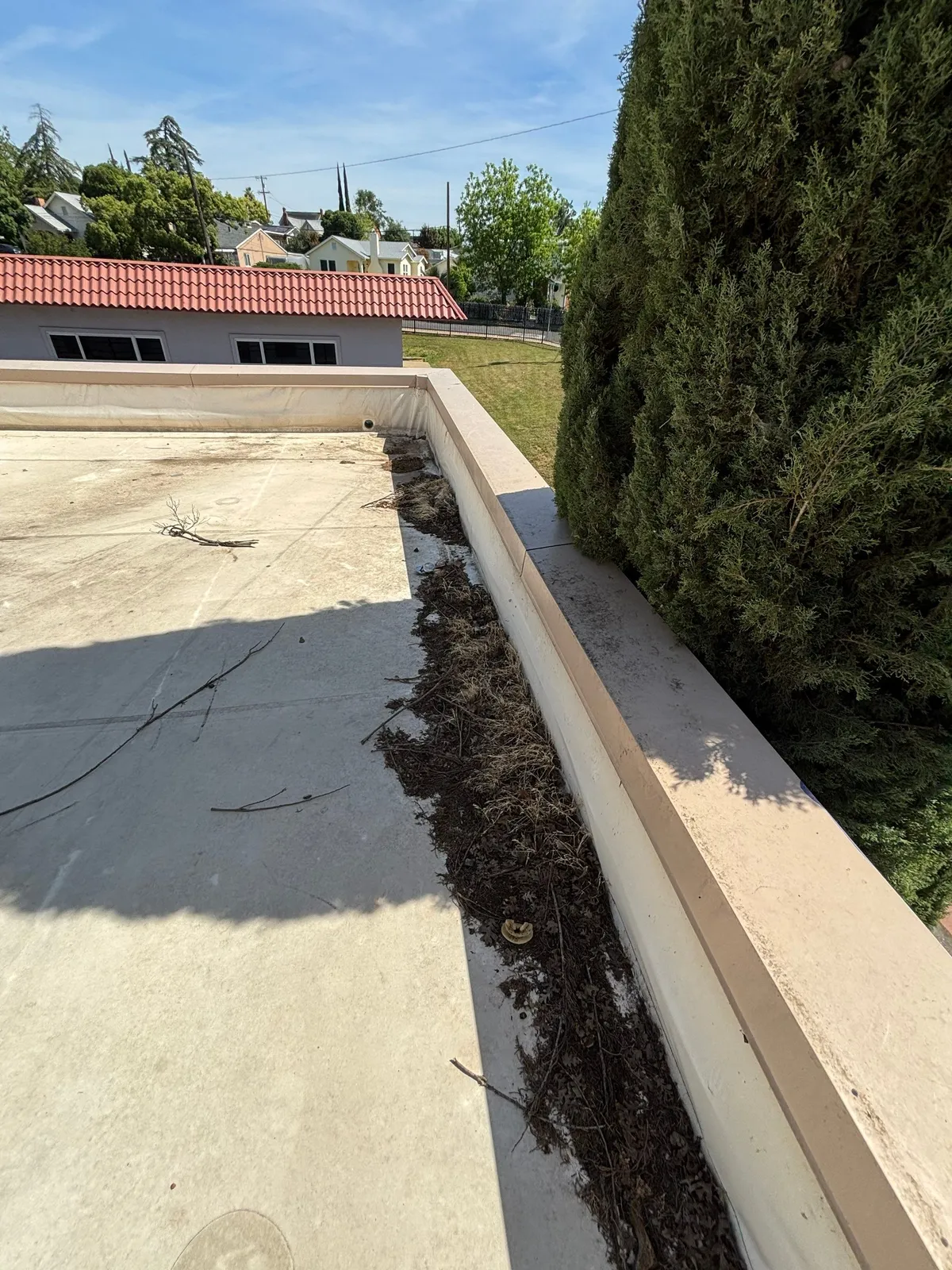
Chico gets about 25 to 27 inches of rain a year, and almost all of it falls between November and April.
That is the whole problem in one sentence.
A roof in the North Valley sits bone dry for five or six months. Sealant cracks. Debris piles up. Small problems have nowhere to go. Then the first real storm arrives, often as an atmospheric river that dumps two or three inches in a day, and every weak spot on the roof gets tested at once.
Our Leak-Stop crews are busiest in the two weeks after the first big storm. Almost every call is something we could have caught in October.
This is the checklist we use. It works for a home in the Avenues and a warehouse on Hegan Lane.
Start with the valleys
A valley is where two roof slopes meet. All the water from both slopes funnels through it. In Chico, it also collects every leaf that falls on the roof.
Valley oaks, sycamores, and the big black walnuts in older neighborhoods drop leaves for weeks. When they pack into a valley, water backs up sideways under the shingles or tile. That is one of the most common leak sources we find on homes near Bidwell Park and along the creeks.
Clean the valleys before the rain, not after. This is exactly what our valley cleaning service is for. If you are on a ladder yourself, clear them by hand and do not use a pressure washer, which drives water and granules where they do not belong.
Gutters and downspouts
A gutter is only useful if water can get out of it.
Walk the perimeter after a windy day. If you see leaves sticking up over the edge, the gutter is full. Clogged gutters overflow at the eave, soak the fascia, and in a cold snap can hold enough water to pull away from the house.
Check that every downspout actually drains. On a lot of Chico homes, the downspout dumps onto a splash block that has shifted, or into a buried drain that has not been clear since the house was built. Water pooling against the foundation is not a roofing problem, but we see it on almost every inspection.
Look at every penetration
Anything that comes through the roof is a possible leak: plumbing vents, furnace flues, skylights, satellite mounts, solar conduit.
Each one is sealed with flashing and a sealant or boot. Summer heat hardens that sealant and cracks it. By fall, a lot of pipe boots on 10-year-old roofs are split around the collar.
This is a cheap fix in October and an expensive one in January when the ceiling drywall is on the floor.
Flat and low-slope roofs need a drain check
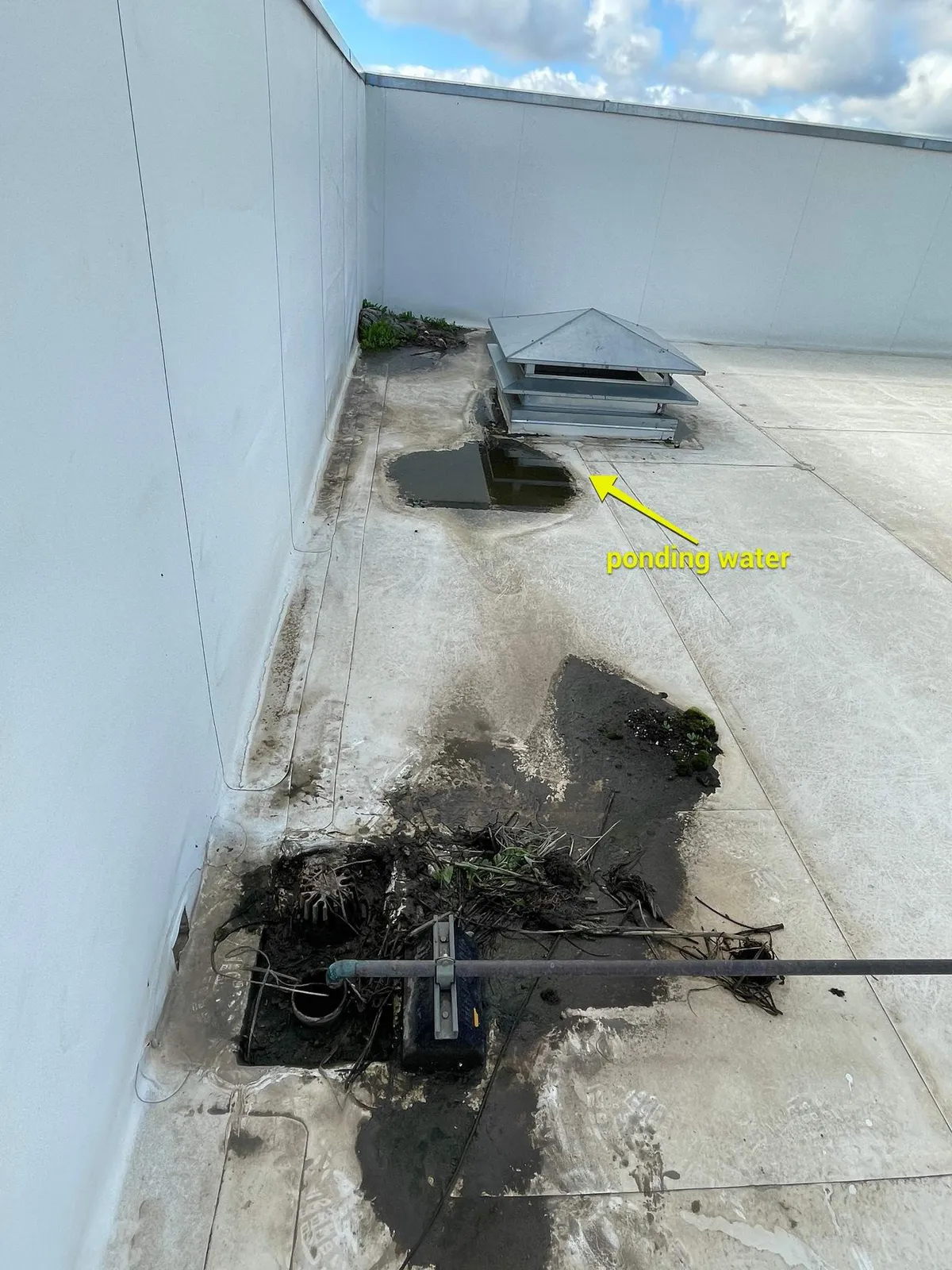
Commercial buildings across Chico, from the airport industrial park to the strip centers on East Avenue, sit on flat or low-slope roofs. Those roofs depend on drains and scuppers to move water.
The photo above is from one of our maintenance inspections. The drain is packed with debris and the water is ponding around it. Standing water on a membrane roof degrades the seams, adds weight, and finds every pinhole.
Before the season, every drain strainer should be cleared, every scupper checked, and any ponding areas noted so they can be addressed. This is the core of our commercial preventative maintenance program and it is why our commercial customers rarely need an emergency call.
Our flat roof maintenance checklist goes item by item.
Check the attic, not just the roof
Some of the best roof inspections happen from below.
Go into the attic on a bright day with the lights off. Any pinpoint of daylight is a hole. Look for water stains on the underside of the decking, especially around chimneys, vents, and valleys. Feel the insulation. If it is damp or compressed in one area, water has been there before and will be back.
If you do not want to crawl your attic, we do it as part of every evaluation.
Trim back what is touching the roof
Branches that rub the roof in the wind wear through shingles and tile. Branches that hang over the roof feed the valleys and gutters all season.
Trim back anything within a few feet of the roof surface. In Chico, the City has rules about street trees and protected oaks, so check before cutting anything large. For trees on your own property, a good arborist is worth the call.
Our article on trees and roofs in the City of Trees covers what the local species do to a roof.
Know who to call before you need them
Here is what happens when a storm hits and your roof leaks at 9 p.m. on a Sunday. You search for a roofer. You call three. Two do not answer. The third is a number you have never heard of, and they want a deposit before they show up.
Do not wait for that night.
Our Leak-Stop request form dispatches a crew to stop the water first and diagnose second. We have run it through every storm season since we set it up, and our customers know it is there.
The fall inspection is the cheapest thing you will do all year
Every item above is something we look at on a fall inspection. Most of the time we find a few dollars of sealant and a couple of hours of cleaning. Sometimes we find a roof that is not going to make it through another winter, and it is a lot better to know that in October than in February.
We have been getting Chico roofs ready for the rain since 1950. We would be glad to look at yours.
Schedule a fall roof evaluation before the first storm.